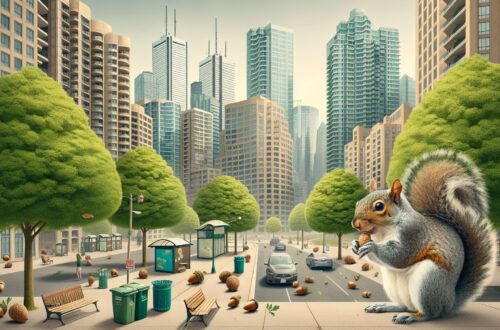
Squirrel movement in Toronto follows clear and consistent patterns shaped by the city’s environment and the animals’ biological needs. Movement includes daily travel, dispersal of juveniles, seasonal shifts in territory, and reactions to human-built features. Across many Toronto neighbourhoods, these movement behaviours reflect the city’s tree cover, housing styles, climate, and food availability.
Biological Drivers of Movement
Squirrels move primarily to find food, shelter, and mates. They rely on mature trees as travel corridors and locations for nests or dens. Movement occurs on a daily basis as squirrels forage for food and check food caches. Seasonal drivers influence movement range and intensity. In spring, males expand travel distances in search of mates. Young squirrels disperse in late spring and summer, moving away from birth sites to establish new home ranges. In fall, movement focuses on collecting and hiding food in various locations across a territory. Winter movement decreases as squirrels stay close to nests or dens to conserve energy and protect from weather.
Movement also reflects territorial behaviour. Adult squirrels maintain home ranges. These ranges overlap to an extent but tend to show territorial boundary marking through vocalization and scent cues. Movement within these ranges is typically predictable, involving repeated routes along tree branches, power lines, and fences.
Influence of Toronto’s Urban Form
Toronto’s diverse urban form influences how squirrels move. Mature tree canopy provides continuous routes for travel above ground and safe access to food and shelter. Areas with dense tree cover show more linear, elevated movement paths. Squirrels avoid ground travel where predator risk and human disturbance are high.
Housing stock shapes travel corridors and movement options. Victorian neighbourhoods with large trees and wide lots offer ample routes for tree-to-tree travel. Post-war bungalows and semis often have smaller, fragmented green spaces. In these settings, squirrels adapt by crossing yards and backing streets, sometimes using overhead wiring. Townhomes and mid-rise areas with sparse trees limit continuous canopy routes, causing squirrels to move more on the ground or to concentrate movement around remaining green patches.
High-rise residential zones often restrict squirrel movement due to lack of trees and green corridors. However, patches of mature trees and urban parks in these neighbourhoods create concentration points for foraging and shelter. Squirrels in such zones may move in more constrained, circuitous paths.
Neighbourhood density also affects movement. In denser areas, squirrels show reduced home range sizes and shorter travel distances due to space limitation and denser competition. In suburban zones with larger lots and ample trees, squirrels move more widely and show complex, overlapping territorial paths.
Seasonal Movement Patterns in Toronto
Seasonal conditions in Toronto strongly influence squirrel movement. Spring brings an increase in travel as male squirrels search for mates. During this time, movement tends to be broader and more erratic. Summer movement sees juveniles dispersing to find own territories. These young squirrels cross neighbourhood barriers and navigate fragmented urban landscapes, showing exploratory movement that gradually settles into defined routes.
In fall, squirrels intensify movement linked to food caching. They travel to multiple spots to hide nuts and seeds. This behaviour spreads across large areas within their home range. Fall movement may bring squirrels closer to human properties, where food sources increase.
Winter movement is limited to short trips to and from protected nests and dens. Squirrels often use cavities in mature trees, attics, or roof spaces for shelter. Inclement weather reduces their need and ability to travel. Despite cold, squirrels continue short-distance movements to recover cached food.
Why These Movement Patterns Persist Over Time
Squirrel movement patterns in Toronto remain consistent across years due to stable environmental and biological factors. The city’s established tree canopy, recurring seasonal cycles, and common housing typologies create a repeatable setting for these behaviours. Mature trees and urban forest patches act as movement arteries that continue to support travel routes.
Breeding and dispersal patterns repeat annually as life cycle requirements remain unchanged. Juvenile dispersal ensures genetic mixing and maintains population spread across urban zones. Seasonal food caching responds to recurring food fluctuations and climate demands.
Urban expansion and some tree loss may alter specifics locally, but overall movement patterns persist at a city-wide scale. The balance between green space availability and neighbourhood design maintains the characteristic linear and area-bound movement paths.
Common Misconceptions About Squirrel Movement
One common misconception is that squirrels move randomly or without fixed territories in the city. Observations show squirrels establish distinct home ranges and regularly use the same routes. Movement is purposeful and linked to strong spatial memory of food caches and shelter spots.
Another oversimplification is that squirrels avoid human areas entirely. Many squirrels adapt to urban environments by moving efficiently along tree lines, jump paths, and even power lines near homes. They use green corridors within neighbourhoods, not just larger forested areas.
Some assume that winter halts all squirrel movement. While activity decreases, squirrels continue brief but crucial movements for food recovery and shelter checks. These low levels of movement are critical for survival during months with scarce resources.
Lastly, people often think urban development makes movement impossible. Toronto squirrels demonstrate behavioural flexibility, adjusting travel patterns to local tree cover and housing types. While some areas restrict movement, squirrels find ways to navigate fragmented landscapes for daily needs.
Summary and Interpretive Insight
Squirrel movement in Toronto unfolds as a set of consistent, biologically driven patterns shaped by the city’s trees, neighbourhood density, housing forms, and seasonal cycles. Squirrels move purposefully within established home ranges, following routes aligned with the mature tree canopy and using urban features such as fences and wires to bridge gaps.
Repeated annual patterns of dispersal, breeding travel, food caching, and winter shelter checks reflect fundamental survival needs moderated by Toronto’s climate and urban structure. These patterns endure because the environmental and biological factors that guide movement remain stable in their broad characteristics, even as neighbourhoods change incrementally.
Common myths simplify movement behaviour in ways that overlook the purposeful and adaptable nature of squirrels. The animals respond flexibly to Toronto’s urban form and seasonal changes, carving travel paths that balance risk, energy expenditure, and access to resources.
Understanding these movement dynamics offers a window into how wild animals integrate with a dense and varied cityscape over time. It highlights the role of mature trees and green spaces as crucial infrastructure not just for parks but also for daily travel and survival of urban wildlife. Reflecting on movement patterns through a Toronto-specific lens reveals the interplay of biology, environment, and urban design in shaping where and how squirrels live and move throughout the city.

Bryan Powell
Bryan Powell documents recurring squirrel behavior patterns observed in Toronto’s urban environment. His writing focuses on how housing stock, seasonal pressures, and structural features influence squirrel activity in residential areas, rather than on removal methods or services.
You May Also Like